
AI products are becoming easier to build.
As models grow more capable and development barriers fall, a new feature launched today may be followed by ten similar products tomorrow. When products are no longer scarce, the questions change: How do you find people who genuinely want to use and pay for your product? And how do you turn one successful attempt into growth that can be replicated consistently?
On August 6, Youdao Ads and EquatorQ jointly hosted the closed-door salon “AI Growth Lab: Building a New Moat for AI Products” in Zhongguancun, Beijing. More than 50 AI company founders, CEOs, CMOs, and growth and marketing leaders attended.
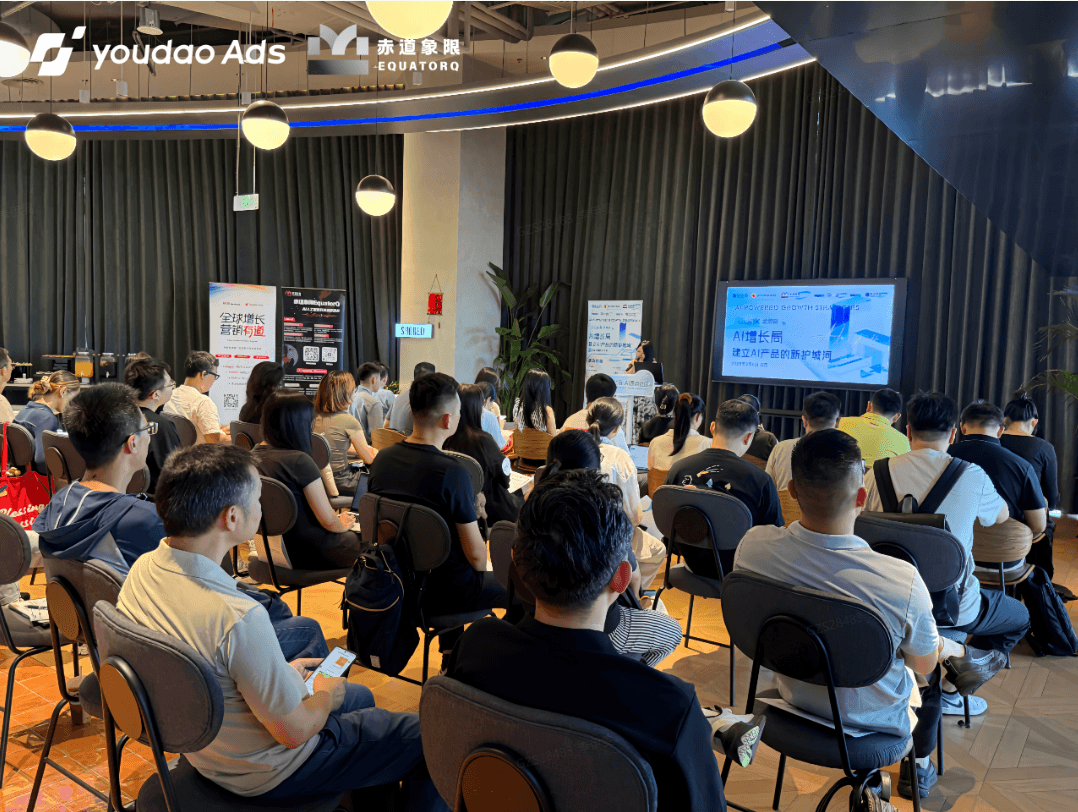



Representatives from Google, Youdao Ads, Kunlun Tech’s Tiangong AI, JQ Fund, and EquatorQ approached one question from different perspectives:
How can AI products move from 0 to 1, from 1 to 10, and then to 100?

For an AI product moving from 0 to 1, the first questions are: Which need should it address, and which market should it enter first?
Rachel Li, Senior Industry Manager on Google Greater China’s Key New Customer team, began with some good news: “The AI market is getting hotter, but leading products are still a long way from capturing all of it.” According to Google data, long-tail products account for more than half of market traffic. Even within an individual segment, the top two products together hold less than a quarter of the market. New products still have opportunities, but those opportunities increasingly lie in specific, narrowly defined user needs.
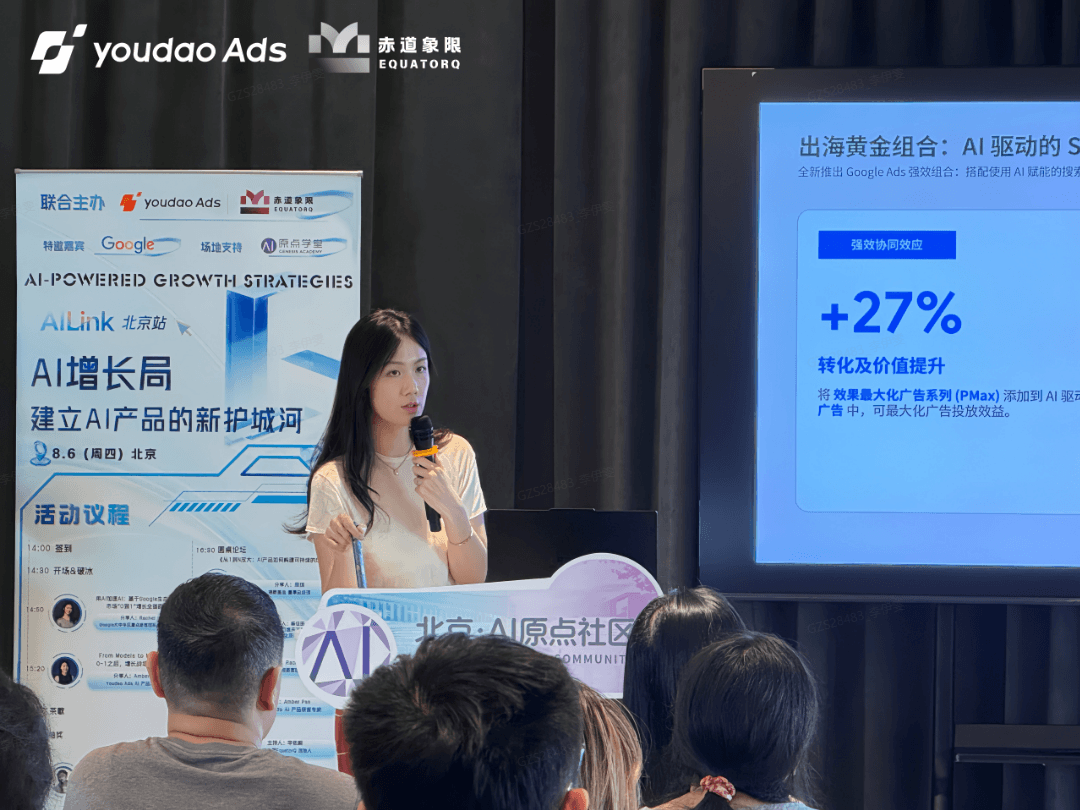
The problem is that, as demand becomes more fragmented, choosing the wrong direction becomes more costly. Image generation, video creation, coding, workplace productivity, AI social applications: different audiences have different reasons for using AI and paying for it. For a product just entering the market, the priority is to identify a sufficiently specific use case that users are willing to pay for.
Only after identifying the right need should the team choose suitable geographic markets.
Different countries serve different growth objectives. Users in the United States have strong purchasing power and a high monetization ceiling, but competition and acquisition costs are also higher. India offers more room for low-cost traffic, while emerging markets such as Indonesia are growing rapidly. Products need to choose between high-value and high-potential markets according to their objectives.
Rachel also advised: “A small budget can help teams test audiences, selling points, and conversion journeys more quickly. But if the product’s value and target users are still unclear, scaling too early will only magnify the existing problems.”

Once a product has its first seed users, how can it find more?
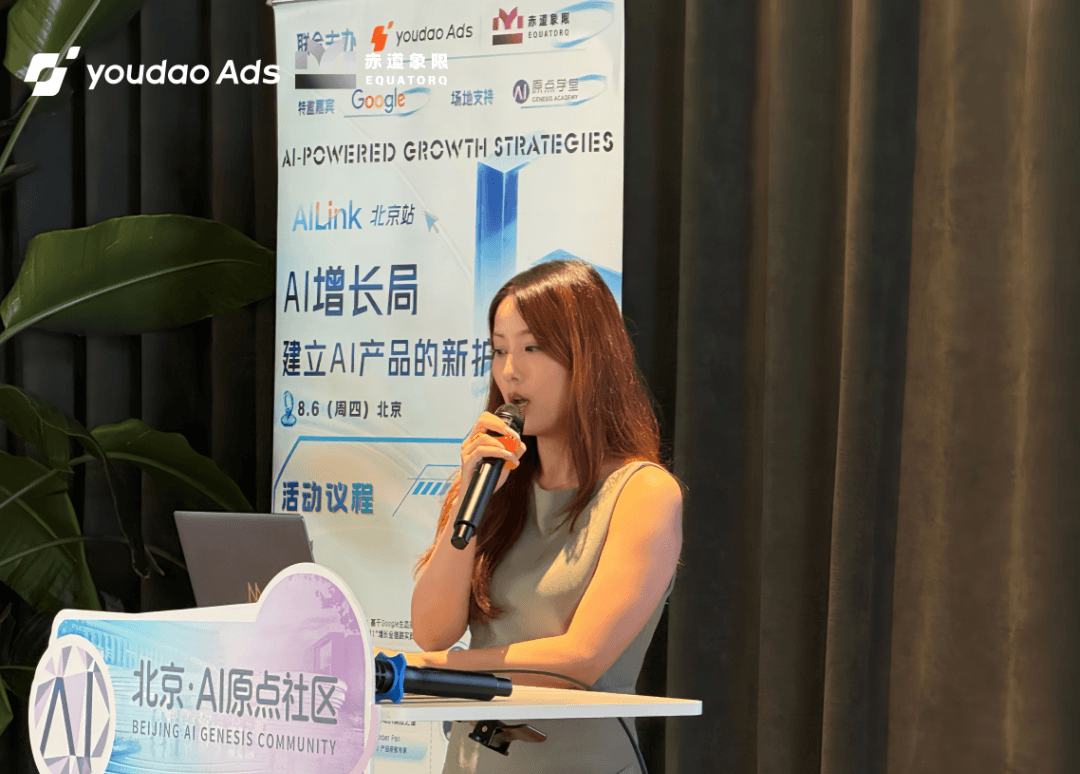
Drawing on experience promoting and growing more than 120 AI products in China and internationally, Amber Pan, Business Lead for the AI Sector in Overseas Advertising at Youdao Ads, explained the integrated growth approach that follows the 0-to-1 stage: find the right communities, validate content, amplify it with paid media, and keep reusing it.
-
Find the right communities. Users of AI products are often spread across specialist use cases. Rather than pursuing mass exposure first, identify the best-matched audiences and then choose the relevant creators, platforms, and content formats.
-
Validate content. However powerful an AI product may be, users still need to understand its value quickly. Youdao Ads summarizes effective creative as Hook–Story–CTA: capture attention, show how the product solves a problem, and then encourage a trial or download. Amber argued that “the content formula matters more than the creator’s audience size.” Establishing a repeatable content structure matters more than betting on a single top-tier creator.
-
Amplify with paid media. Once content has proved effective, obtain authorization to promote it through formats such as Partnership Ads and Spark Ads, extending its reach beyond the creator’s existing followers and lengthening its useful life. “Paid acquisition alone is increasingly insufficient; creator content is becoming an advertising asset that can be amplified continuously.”
-
Keep reusing it. Successful videos can be re-edited, distributed across platforms, or even used as a basis for AIGC versions of proven content structures. Find what works, then keep replicating it.

Marketing can amplify one success. But as the user base grows, the product itself must answer another question:
Can it consistently deliver good results for different users and in different situations?
Yang Zhengxin (Adam Star), Head of Large Model Commercialization and Marketing at Kunlun Tech’s Tiangong AI, used the AI music generation product Mureka to explain the central change required in the 10-to-100 stage.
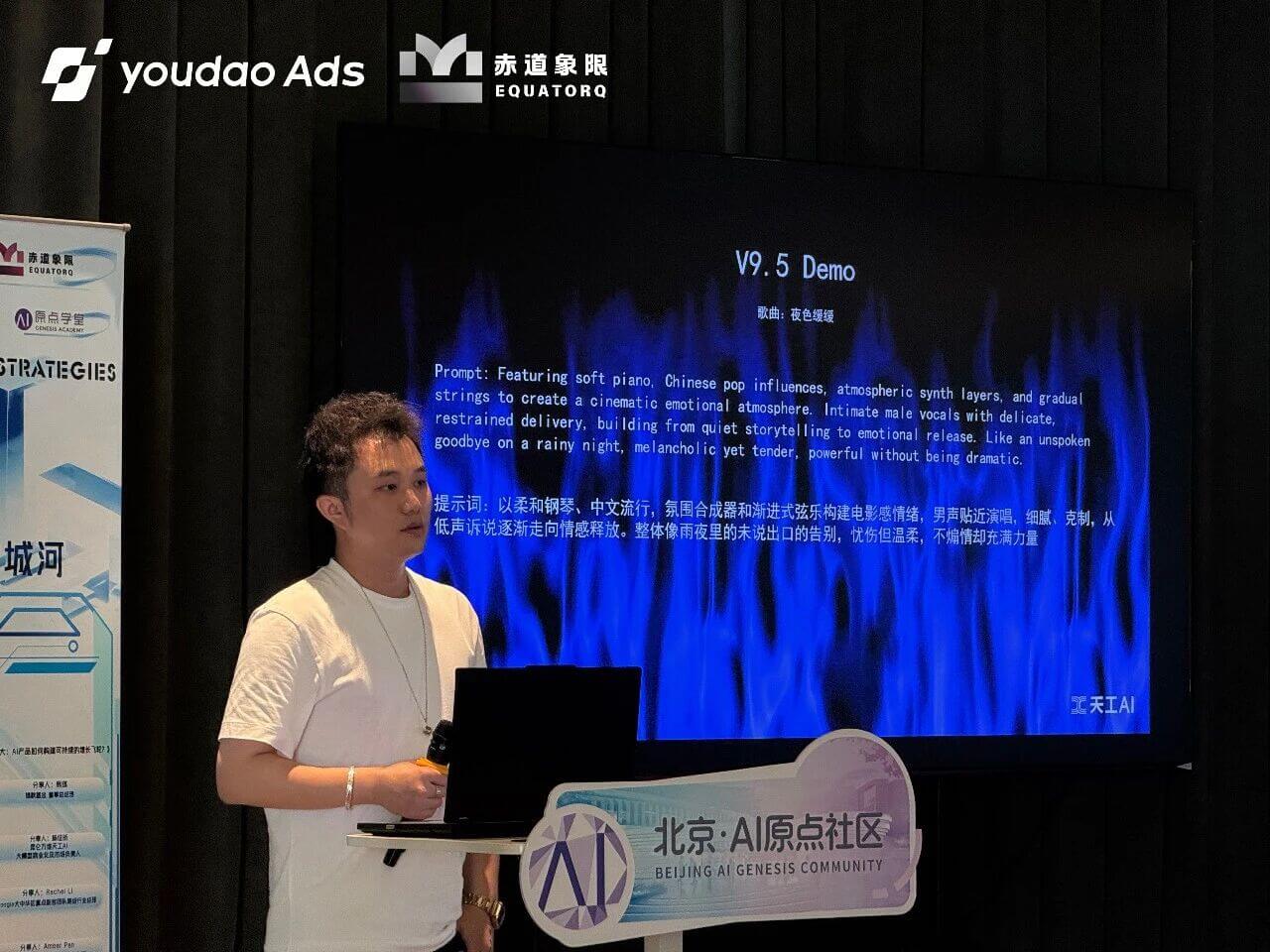
“The key to growth from 10 to 100 is turning occasional success into consistent success.”
For an AI music product, occasionally generating an impressive song demonstrates what the model can do. But if users must repeatedly try their luck to get one good result, that capability has not yet become a reliable product experience.
Mureka breaks scalable replication down into three requirements:
-
Consistent usability: Good results cannot depend on luck. More of the generated output must meet a usable standard.
-
Accuracy and control: The model must understand the style, mood, vocals, and expression users want more accurately and consistently.
-
Naturalness and authenticity: A single pleasing passage is not enough. Arrangement, vocals, structure, and emotional progression must all be more complete, reducing the obvious signs of AI generation.
This logic applies to other AI products too. An impressive demo shows that something is possible; reliable delivery determines whether it can scale. Ultimately, what the Mureka team wants to replicate is no longer a particular good song.
“We are replicating a creative capability, not a song.”
Stable model capabilities, standardized workflows, and reusable assets are what turn a single success into a repeatable product capability.

After the first three presentations, EquatorQ founder Li Yitong joined JQ Fund Managing Director Zhou Qi, Kunlun Tech Tiangong AI’s Head of Large Model Commercialization and Marketing Yang Zhengxin, Google Greater China Senior Industry Manager Rachel Li, and Youdao Ads’ Overseas Advertising AI Sector Business Lead Amber Pan for a roundtable that brought the discussion back to the realities of building a business.

Question One When Should a Product Start Advertising
Rachel’s view was that teams should validate the product, audience, and core selling points to a reasonable degree before using advertising to scale. “Advertising is primarily an amplifier; it is difficult for it to create something for you from nothing.”
Amber added that once a campaign enters the scaling stage, rising costs do not necessarily mean growth has failed. As the audience expands, acquisition costs may naturally rise. What matters more is upgrading creative assets, optimization objectives, and team capabilities alongside the budget.
Question Two Where Can a Moat Be Built When Features Are Easy to Copy
Zhou Qi argued that, as product features become easier to copy, commercialization capabilities will play an even greater role in a startup’s success. Building the product supplies the initial “1”; the ability to keep acquiring users, grow revenue, and eventually establish a brand determines whether the following “zeros” can be added. A larger user base also enables a stronger data feedback loop for product iteration, helping the product stay ahead and move from a niche market into the mainstream.
Question Three Is Growth Only About Selling the Product
Drawing on Kunlun Tech’s Tiangong AI experience, Yang Zhengxin offered another perspective: “Growth is not only about taking a product to market. The market also shapes the product.”
A substantial share of Tiangong AI’s business now comes from overseas. Differences in user needs, content preferences, and culture across countries continuously feed back into its products and models. Real market feedback gathered through user-facing products and content platforms also informs further iterations of the foundation models.
Growth is therefore part of ongoing product development.
Question Four Should Founders Handle Growth Themselves
Zhou Qi’s answer was direct: “You should be your product’s first salesperson.”
If founders do not understand why users buy or refuse to buy, and have not engaged with the market themselves, external sales teams, advertising, and distribution channels will struggle to take the business from 0 to 1 on their behalf.
“Online advertising and offline channels are both, at their core, amplifiers.”
This does not mean founders must always monitor ad accounts or produce creatives themselves. It means that, at least in the early stages, understanding users, the market, and how growth works cannot be outsourced completely.
Looking back at the event, Google addressed how to identify needs and markets; Youdao Ads explained how to scale effective marketing methods; Kunlun Tech discussed turning one product success into a reliable capability; and investors and founders repeatedly brought the conversation back to the fundamental question: Why do users choose you?
What may be truly scarce in the next phase is more than another new feature. It is a company’s ability to keep understanding users, find markets quickly, establish effective approaches, and replicate success reliably.
Moving from 0 to 100 does not simply mean multiplying the budget or user count by 100.
The real change is moving from succeeding this time to understanding why it worked and being able to succeed again next time.
That may be the point at which an AI product truly begins to build a growth moat.
Youdao Ads has supported domestic and international growth for more than 120 AI products, developing AI-sector growth solutions spanning influencer marketing, performance advertising, AIGC creative assets, and global promotion.